nobaaibkcalggmjnjhnlmmcldllpogjp

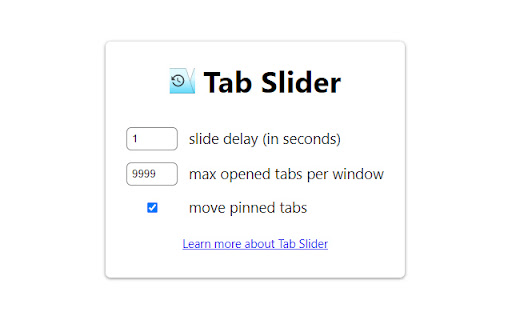
Keep your tabs ordered by their most recent usage. 🔥 BOOST YOUR BROWSING EXPERIENCE! 🔥 This extension keeps your browser tabs sorted in Most Recently Used (MRU) order, from left to right — just like the way apps are organized on desktop operating systems when you use Cmd/Alt+Tab. Tab Slider brings this behavior to Chrome. Try it out! - If you stay on a tab for more than 1 second (by default), it will "slide" to the leftmost position; - This keeps your most recently used tabs ordered from left to right; - Thanks to this order, pressing Ctrl+Tab switches you to the next most recently used tab; - Pinned tabs slide in the opposite direction (left to right). This is intentional — it allows seamless switching between your most recently used pinned tabs and normal tabs using keyboard shortcuts: - Ctrl+Shift+Tab switches to the most recently used pinned tab; - Ctrl+Tab switches back to the most recently used normal tab; You can customize the reordering delay and the maximum number of reordered tabs in the extension’s settings; newly opened active tabs immediately appear on the left. Once you get used to it, this way of managing tabs will feel completely natural and intuitive 🪄

QuicKey – The quick tab switcher
Now you can press a single shortcut key (ALT-Q by default) to navigate recent tabs in a popup window, just like the ALT-TAB menu! Keep holding ALT while pressing Q to move the selection, then release ALT to switch to the selected tab. *️⃣ Switch between the most recently used tabs ⚠️ NOTE: If you've been using QuicKey before 2.0, you'll need to set keyboard shortcuts for the new commands that show the popup window, as they won't be set by default. Opening QuicKey displays a list of the last 50 tabs you've visited, in order of recency. (When you first start using QuicKey, though, it won't know what's recent, so the list will be empty.) Click a tab to switch to it, or use one of the keyboard shortcuts below to navigate the recently used tab history. 🔶 To pick a recent tab from the MRU list in the popup window: • Press ALT-Q (CTRL-W on macOS) but keep holding the modifier key. • Press Q or ↓ to move down through the list of recent tabs. • Press SHIFT-Q or ↑ to move up. • Release ALT (or CTRL) to switch to the selected tab. • You can also highlight an item with the mouse, then release ALT/CTRL to go to that tab. 🔶 To quickly switch between the two most recent tabs: • Press ALT-Z (CTRL-S on macOS). You can also view each tab as you navigate through the recents list, taking as long as you want on each, and then release the modifier key to stay on that tab. Make sure the shortcuts are set by right-clicking the QuicKey icon and selecting Options. Then click "Keyboard shortcuts", scroll down, and click "Change browser shortcuts". Look for the "Switch to the previous/next tab" commands and set these suggested shortcuts: ALT-A and ALT-S, respectively (CTRL-D and CTRL-S on macOS). 🔶 To navigate while viewing each recent tab: • Press ALT-A (CTRL-D on macOS) to display the previous tab, but keep holding the modifier key. The popup window will stay open on the right side of the screen. • Press A again to move down the list, displaying each tab in turn. • Press S to move back up. • Release ALT (or CTRL) to stay on the current tab. • Press ALT-A again to switch back to the tab you initially started on. *️⃣ Search for a tab quickly Unlike other tab switchers, QuicKey uses a Quicksilver-style search algorithm to rank the results, where contiguous matches at the beginning of words are higher in the list, as are matches against capital letters. So you should only have to type a few letters to quickly find the right tab. 🔶 To search for a recent tab in the popup window: • Press and release ALT-W (CTRL-W on macOS). • Type one or more search terms, separated by spaces. • Use one of the shortcuts below to navigate the list. • Press ENTER to switch to the selected tab. • ↓, SPACE or CTRL-N/J: move down the list • ↑, SHIFT-SPACE or CTRL-P/K: move up the list • PG DN: page down the list • PG UP: page up the list • END: go to the bottom of the list • HOME: go to the top of the list • ENTER: switch to the selected tab • ESC: clear the search or close the popup window or menu Recently used tabs get a slight boost in the search results ranking, so getting back to a tab you were just using should require typing fewer letters. Typing a space lets you enter multiple tokens in the query, all of which must match either the tab's title or URL, in any order. If you type more than 25 letters, which should be plenty to find the right tab, QuicKey switches to an exact string search to stay fast. *️⃣ Customize shortcuts and other options To customize how QuicKey behaves, click the gear icon in the popup window or menu, or right-click its icon on the toolbar and select Options. There you can: • Customize keyboard shortcuts • Change the popup window's behavior • Hide closed tabs from the search results • Limit tab navigation or search to the current browser window • Mark tabs in other browser windows with an icon • Show the number of open tabs • Restore the last search query when reopening the popup window or menu • Use pinyin to search for Chinese characters When a QuicKey update adds new settings, the gear icon will display a red dot to let you know. *️⃣ Limit navigation to the current browser window If you have multiple browser windows open, you may want to navigate among only the recent tabs that are in the current window. To enable this behavior, open the Options page to the General tab and select "Limit recent tabs to the current browser window". Pressing the shortcuts for "Switch instantly between the two most recent tabs" or "Switch to the previous tab" will then switch only between recent tabs in the current window. You can also limit searching for tabs to the current browser window. *️⃣ Close and reopen tabs To close the selected tab, press CTRL-W (CMD-CTRL-W on macOS, CTRL-ALT-W on Linux). Or hover over a tab and click the X button on the right side of the list. When you open QuicKey, the 25 most recently closed tabs are listed below the recent tabs and shown in a faded state with a clock icon. They are also returned when you type a query, though their rank in the list of results is lower than open tabs. Click a closed tab to reopen it in its original location and with all of its browsing history intact. If you don't want any closed tabs to be shown, open the QuicKey options page, then uncheck "Include recently closed tabs in the search results" in the General section. You can also remove the selected closed tab from the browser's history by pressing CTRL-W (CMD-CTRL-W on macOS) or by clicking its X button on the right side of the list. You can move tabs to the left or right of the current tab, making it easy to pull tabs from other windows into the current one, or to rearrange tabs without using the mouse. • Press CTRL-[ to move the selected tab to the left of the current one. • Press CTRL-] to move it to the right. The CTRL key should be used on both Windows and macOS. Note that you cannot move tabs between normal and incognito windows. *️⃣ Distinguish tabs with identical titles A tab that has the same title as other open tabs will display a number to indicate its left-to-right position among those other tabs. For instance, if you open tabs for two different Google Drive accounts, they'll both be titled "My Drive - Google Drive". But the one on the left will show a "1" next to its title in the list and the one on the right will show a "2". This makes it easier for you to select the tab you want when you know how they're organized in your window. To find a bookmark, type "/b" and a space in the search box, then part of the bookmark's name or URL. • Press ENTER to open it in the current tab. • Press CTRL-ENTER (CMD-ENTER on macOS) to open it in a new tab in the current window. • Press SHIFT-ENTER to open it in a new window. As soon as you type "/b ", your bookmarks will be listed in alphabetical order, in case you want to browse through them. Since bookmarks can be organized into folders, the folder path is shown before each bookmark's title. The folder path can be hidden by unchecking "Show the folder path to each bookmark in its title" on the Options page. *️⃣ Search the browser history To find something in the last 2000 pages of your browser history, type "/h" and a space in the search box, then part of the page's name or URL. The same CTRL-ENTER (CMD-ENTER on macOS) and SHIFT-ENTER shortcuts will open the visited page in a new tab or window. As soon as you type "/h ", the pages from your history will be listed in order of recency, so you can get back to a page you had recently visited without having to remember its name. *️⃣ Delete bookmarks and history items To delete the selected bookmark or history item, press CTRL-W (CMD-CTRL-W on macOS). Or hover over an item and click the X button on the right side of the list. You'll be asked to confirm the deletion of bookmarks. To switch to incognito tabs as well as normal ones, right-click the QuicKey icon and select Options from the menu. Scroll to the very bottom of the General section and then click the "Change incognito settings" button. On the extensions page that opens, scroll down to the "Allow in incognito" option and click the toggle button next to it. Tabs in incognito mode display the incognito icon under the page's favicon, so you can distinguish a normal tab from an incognito one with the same title. You can also copy the URL and title of the selected tab, bookmark or history item: • Press CTRL-C (CMD-C on macOS) to copy just the URL. • Press CTRL-SHIFT-C (CMD-SHIFT-C on macOS) to copy both the item's title and its URL, one per line. When first installed, QuicKey asks for these permissions: ➤ "Read and change your browsing history on all your signed-in devices" QuicKey uses this permission to let you search the titles and URLs of the open tabs, as well as pages from your history. The "all your signed-in devices" part is there only so that recently closed tabs can be restored with their full history. The only time QuicKey changes your browsing history is when you choose to delete a history item. ➤ "Read and change your bookmarks" QuicKey uses this permission to let you search the titles and URLs of your bookmarked pages. The only time it changes your bookmarks is when you choose to delete one. QuicKey can't access or manipulate the content of any pages you visit and doesn't transmit any information other than some anonymized diagnostic data. If you right-click the QuicKey icon on the toolbar, there's a message saying "Can't read or change site's data", which is a bit misleading, since it can't read or change *any* site's data, not just the current one. *️⃣ Support and source code Open the Options page and click the About section to get quick access to these links: View the release history at https://fwextensions.github.io/QuicKey/releases See the source code at https://github.com/fwextensions/QuicKey

CLUT: Cycle Last Used Tabs
This extension tries to mimic the ALT+TAB behavior from Windows(or Command+TAB in Mac) to allow to switch between open tabs in a Most Recently Used fashion. It remembers the order in which you switched tabs (made a tab active) and it updates its records so that you can switch to the recently used ones quickly. Note: Sometimes after updating the extension the keyboard shortcut settings get reset. Hence you might want to set the desired keyboard shortcuts again in the keyboard shortcut settings in the Chrome Extensions page. Alternatively, navigate to chrome://extensions/shortcuts from your address bar to change shortcuts. Please rate and comment. The project is made open source in GitHub: https://github.com/harshayburadkar/clut-chrome-extension.git Default Keys*: ALT+W: Quick switch ALT + S: Normal switch ALT + Shift + S: Normal switch (in opposite direction) *Keys can be changed in keyboard shortcut settings on the Chrome extensions page. =Quick switch=: Use for rapid switching to last tab (by pressing once) or to the second to last used tab(by pressing rapidly twice) and so on. =Normal switch=: Use when you want to look for a tab recently used but when you would want to go in a slower pace (needing to glimpse for a bit to see if it is the page you need) Most other extensions meant to accomplish the same thing don’t work well since there are some limitations/difficulties in the Chrome API. This extension uses some basic algorithms and timers of intervals between key presses to get over these problems. That is the reason there is separate keys for quick and slower switches with different timer settings. Features: * Can cycle through ALL open tabs from all Chrome windows in a most recently used order * Extension DOES NOT need access to any of your visited website's data * Can work through tabs across different Chrome windows * Snappy and fast switches - Why are there two sets of shortcuts one for quick switch and one for a slower switch. Isn’t it possible to simplify like ALT+TAB behavior ? A: There are some restrictions in Chrome API which makes it difficult to implement this feature in the most natural way. The intention was to make this extension work as close to Alt+Tab in Windows (or Cmd+Tab for Mac). Unfortunately due to these limitations though, this extension relies on time intervals in between your key presses. That is the reason there is a concept of quick switch (faster timer) and a normal switch (slower timer). - Where can I change the shortcut key for switching tabs ? A: To change shortcut, go to the Extensions pane in your Chrome browser. Press the menu icon and find the Keyboard Shortcuts option in the list. You can change keyboard shortcuts of your installed extensions and apps here. Alternatively, you can access and change extension keyboard shortcuts by going to this special address from your browser address bar. chrome://extensions/shortcuts Note: Few shortcuts may be not allowed to be set by Chrome if Chrome itself uses that shortcut or the shortcut is needed for system level operations. Feel free to post feedback, comments and suggestions.

Tab Slideshow
Create a slideshow based on the open tabs in your browser window. Tab Slideshow allows you to cycle through open tabs in a particular browser window as though each tab were a slide in a slideshow or presentation. The functionality is simple: press the Tab Slideshow icon in your extension tray, input the interval length (the amount of time to spend on each tab) and press 'Begin'. Tabs will then change automatically after the specified interval of time is up. The slideshow stops when a new tab/window is created, an existing tab is closed or you press the 'Stop' button from within the popup window. --- If you find this extension useful, but wanted the ability to add a refresh interval, try out Tab Slideshow Plus (https://chrome.google.com/webstore/detail/iaehgcjemgeldahhdeafbdeglfbaecll)! It's basically the same extension with the only difference being the refresh interval parameter, but I didn't want to introduce any bugs in this version.

close_tab(s)
Easily close tabs with in-page elements. More easy and fast way to close tabs. Allows you to easily close tabs with in-page elements. Features: ---------------- • You can close the active tab by clicking to the selected in-page edge element. • In-page element only appears when you move the mouse cursor to the selected edge. • You can change the features of the in-page element, like hover color, thickness, click event type and position. • Use toolbar icon or context menu to close tabs. Limitations: -------------------- Since Chrome is not allowing, we can't add in-page element into the following pages: chrome:// - chrome-extension:// - chrome-devtools:// - view-source: - data: - chrome.google.com/webstore/ - New tab page. But, toolbar icon and context menu options will continue to work on all pages without any limitation. Note on permissions: ----------------------------------- • with v4.0, new "scripting" permission request added. In previous versions, i was using "chrome.tabs.executeScript()" to reflect settings changes into pages, but with Manifest V3, it is moved to "chrome.scripting.executeScript()", which requires "scripting" permission. • "Read and change all your data on the websites you visit" - That is necessary to insert In-Page element into pages. I do not read your data from any website, nor do i modify it. New features: • Pinned tabs will not be closed (by default). • Store data in memory for faster access. Updates: • Upgraded to Chrome Manifest V3. • Closing multiple tabs is now faster. • The name of the extension has been changed to 'close_tab(s)'. • Some UI changes. Fixes: • Fixed an issue with slow-loading sites. v3.0.x New features: • New add-on features for bottom and right positions. • Tooltips now customizable. • In-page element opacity feature. • Right-click on the selected edge, shows selected options. • Context menu options added. • Auto maxizing new windows feature added. • Toolbar icon popup page added. • Spanish and Portuguese language support added. Updates: • Settings page redesigned. • In-page element positions restructured. • New toolbar icon images available. v2.0.x New features: • New in-page closer positions added. • You can change thickness of the in-page element. • Toolbar icon is added. Clicking to the toolbar icon will close the active tab. • You can change the toolbar icon image. • Multi language support is added, so please help to translate. • Preferences synced with Chrome (if signed in). Updates: • Renamed to 'Close This Tab'. • New Options/Settings page. • Injecting the element into dynamically loaded pages.