mbkehkfjhncahcaggkncdaacfnikmoid


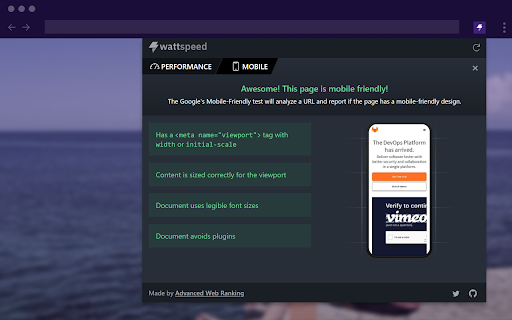
Wattspeed is a browser extension that offers powerful web technologies insights each time you open a new web page. Get powerful web technologies insights each time you open a new web page. - Mobile-friendly test - Google Lighthouse scores - Core Web Vitals for the last 28 days - Security audit - HTML5 validation - Accessibility checker - Mixed content & JSON-LD structured data snippet detection and more... - What web server is behind the URL? - What Analytics tool is used to get visitor insights? - What Marketing or Chat tools are used to convert the visitors? - What Advertising network is running in order to sell ads? - What CMS powers the forum, blog or the online shop? - What CSS and JS frameworks are used to build that user interface?

View Rendered Source
View source is dead. See how the browser renders a page, not just what the server sends. A lightweight Chrome Extension that shows you how the browser has constructed (rendered) a page's original HTML into a functioning DOM, including modifications made by JavaScript. An essential tool for web developers using JavaScript frameworks like Angular, ReactJS and Vue.js, and for SEOs to understand how search engines see your pages, especially considering Google's dynamic serving workaround. Differences between raw and rendered versions are highlighted line-by-line showing how JavaScript has modified a page at render time. * Raw: The source code sent from the server to the browser before the DOM is rendered. The same as you'll see with traditional 'View Source' in the browser (after minor formatting tweaks) * Rendered: The rendered page after the source has been interpreted into a DOM, including any modifications made by Javascript * Difference: The difference between the rendered source and the raw source. Differences occur when JavaScript has modified the DOM. Adaptive website? If you serve different source code to mobile devices, emulate this easily with a mobile user-agent checkbox. Dynamic serving for Google? (More info: https://developers.google.com/search/docs/guides/dynamic-rendering) Using Google's dynamic rendering workaround designed for Javascript-heavy sites? Just request the raw source as Googlebot and ensure perfect technical SEO. Works with GatsbyJS and Prerender. DM the developer: https://twitter.com/ItsHogg

OpenLink Structured Data Sniffer
What is it? The OpenLink Structured Data Sniffer (OSDS) is an extension for Web Extensions compliant browsers (e.g., Google Chrome, Microsoft Edge, Opera, and many others) that discovers Metadata embedded within HTML documents as Structured Data Islands and presents what's discovered using a Property Sheet presentation style. Currently, OSDS supports discovery and processing of Structured Data Islands published using notations such as Microdata, RDFa, JSON-LD, RDF-Turtle, RDF-XML, CSV, and JSON. Why is it important? It simplifies the process of understanding what a given HTML document is about, via its metadata, for both end-users and developers. For instance, it helps Digital Brand Managers, Digital Content Managers, and Semantic Search Engine Optimization (SSEO) practitioners understand what may or may not be affecting Search Engine Results Pages (SERPs) placements. Simply install the extension to your browser and then visit a page of interest. On page arrival, the OSDS icon will be visually activated thereby indicating metadata discovery; once the icon is clicked, you will be presented with a presentation of transformed metadata.

Link Redirect Trace
The all-in-one redirect path analyzer. It also analyzes protocol headers, REL-canonicals, robots.txt, backlink power, and trust! Perform advanced, comprehensive, and correct analysis of redirects and REL-canonicals. Get the complete picture on every redirect. Use this extension for your SEO analysis, On page SEO, Off-page SEO, competitor analysis, and more. - if robots.txt blocks crawlers from a redirect (checked via robots.txt for or X-Robots-Tags in HTTP header); - which URL drops cookies; - the LRT Power and LRT Trust of each URL; - supports NOINDEX/NOFOLLOW tags on every redirect step; - check for other technical issues like Bot-specific blocking. Full Description: https://smart.linkresearchtools.com/seo-tools/link-redirect-trace-extension

Core SERP Vitals
Show the Core Web Vitals data from the Chrome User Experience Report in the Google Search Results. Show real world Core Web Vital data from the Chrome User Experience Report in the Google Search Results. Displays LCP, FID, CLS (and the experimental INP and TTFB) metrics underneath the page links in the Google SERP where data is available in the CrUX report. * Note: Requires a free API key for the Chrome UX Report API. * https://developers.google.com/web/tools/chrome-user-experience-report/api/guides/getting-started Updates: Version 1.3.0 - Now displays the experimental INP and TTFB metrics.