iiekmbomdcmddchlplbdlkkpdgncgpdg


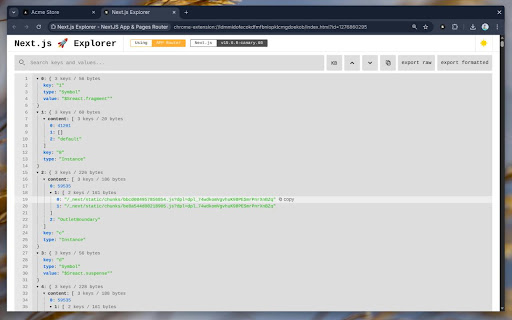
Quickly check if a webpage is built with Next.js and explore static properties and other related NextJS useful metrics. For Next.js Pages Router and App Router Next.js Explorer is a browser extension that helps developers explore and visualize the structure and data of their Next.js applications. When you click the extension icon, a new tab opens where you can browse client-side data and data models generated by your Next.js app. The interface includes a search input to quickly find specific entries. You can copy individual values or export all available data as JSON for further inspection or debugging. This extension is compatible with Next.js Pages Router and Next.js App Router, up to Next.js v16.

Next.js Detector
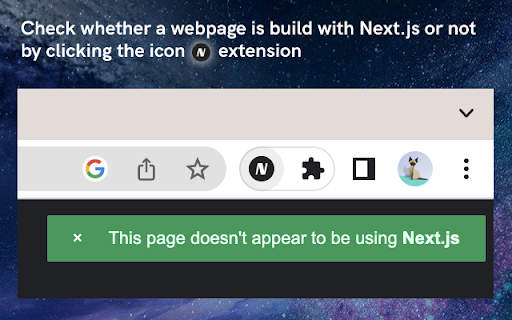
Comprehensive Next.js detection tool - detects version, router type, features, deployment platform, and more. A lightweight Chrome extension that instantly detects if a webpage is built with Next.js framework. Next.js Detector is a lightweight Chrome extension that helps developers quickly identify whether a webpage is built using the popular Next.js framework. By analyzing the page's source code, this extension checks for Next.js-specific patterns and provides comprehensive insights about the Next.js implementation. • Instant Detection: Automatically detects if the current webpage is powered by Next.js • Router Type Detection: Identifies whether the site uses Pages Router or App Router • Version Detection: Shows the Next.js version being used • Build Information: Displays build ID and timestamp • Feature Detection: Detects Image Optimization, Font Optimization, API Routes, Server/Client Components, and Middleware • Statistics: Shows usage counts for Next.js features (images, links, scripts, API routes) • Deployment Detection: Identifies deployment platforms (Vercel, Netlify, etc.) • Environment Detection: Distinguishes between development and production environments • Copy to Clipboard: Export all detection data as JSON for further analysis • Simple Interface: Displays results in a clean, modern, and easy-to-read popup • Lightweight and Fast: Minimal impact on browser performance 1. Click the extension icon while browsing any webpage 2. The extension automatically analyzes the page's source code 3. View comprehensive information about the Next.js implementation, including: - Router type (Pages Router vs App Router) - Next.js version - Build information - Features in use - Statistics and usage counts - Deployment platform - Environment details • Quick Identification: Instantly identify Next.js-powered websites for debugging or learning purposes • Technology Stack Analysis: Gain insights into the technology stack of any webpage • Development Workflow: Understand how Next.js is implemented in real-world applications • Learning Tool: Discover Next.js features and patterns used across different websites • Debugging: Quickly check Next.js version and configuration when troubleshooting • Save Time: No need to manually inspect page source, network requests, or browser DevTools • Learn and Explore: Discover how Next.js is used in real-world applications • Comprehensive Analysis: Get detailed information about Next.js implementation beyond simple detection • Developer-Friendly: A must-have tool for developers working with Next.js or exploring web technologies • Lightweight: Minimal resource usage with no impact on browsing speed • Free and Open Source: Completely free to use The extension analyzes multiple indicators to detect Next.js: - __NEXT_DATA__ object (Pages Router) - /_next/static/ assets (App Router) - Next.js meta tags and data attributes - Script and link tags with Next.js patterns Next.js Detector operates entirely locally in your browser. It does not: - Collect or transmit any data - Track your browsing habits - Require internet connectivity (after installation) - Store any information All analysis is performed on the client-side, ensuring complete privacy and security. 1. Click "Add to Chrome" on the Chrome Web Store 2. Confirm the installation 3. Start detecting Next.js websites immediately!

NextScraper
Easily view & export data from Next.js/React sites. Generate snippets in multiple languages to jumpstart your web scraping project. 🚀 NextScraper - Supercharge your web-scraping project! 🚀 NextScraper helps you analyze and export data from Next.js and React websites, so you know exactly how to build your next web-scraping project. Use the generated code snippets to jumpstart your next scraping project, scraping pure JSON data from pages without the overhead of loading a headless browser! 📊 Scrape Data from React/Next.js Sites: Extract information from dynamic web applications instantly. Analyze and explore it right in NextScraper. 💾 Export Data: Export data from Next.js and React sites with ease. Download JSON files in one click. ✍️ Code Snippet Generator: Save time by letting NextScraper create fast code snippets that allow you to scrape data without loading a headless browser. Your data stays secure within your browser. NextScraper does not collect any analytics, and the source code is openly available on GitHub. Build it yourself with the instructions below for peace of mind. Read our Privacy Policy on Github for more details. 🌐 Connect with Me! If you like this extension, connect with me on X, follow me on LinkedIn, check out my GitHub, or buy me a coffee! ☕

Zukeeper: Devtools for Zustand
Devtools for Zustand, in Zustand Zukeeper is a native, holistic developer tool for Zustand that provides powerful insight into the state of your Zustand application. Check out features such as Action Dispatch logs, State value captures, State Diff-ing, State Hierachy visualization, and Time Travel Debugging!

NextInspect
Network observability tool for Next.JS NextInspect is a developer tool that allows Next.js developers to see network request metrics in Server Side Rendered(SSR) components. Metrics are displayed in a format similar to the native Chrome network devtools, so onboarding and usage is a breeze. Metrics for network requests made in Client Side Rendered components are also shown, eliminating the need to click back and forth between the native Chrome devtools and NextInspect. Please also install the NPM package for NextInspect onto your Next.js app.