fpnmgdkabkmnadcjpehmlllkndpkmiak

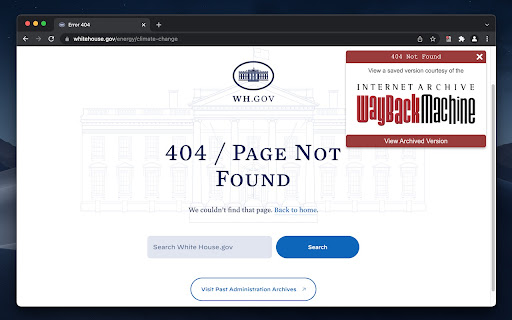
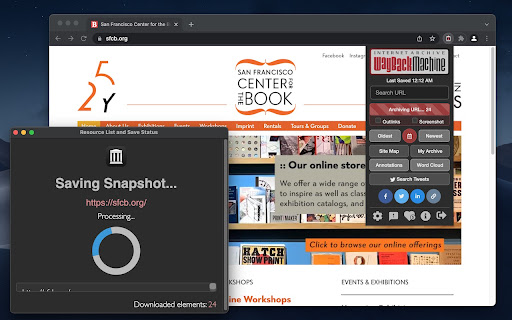

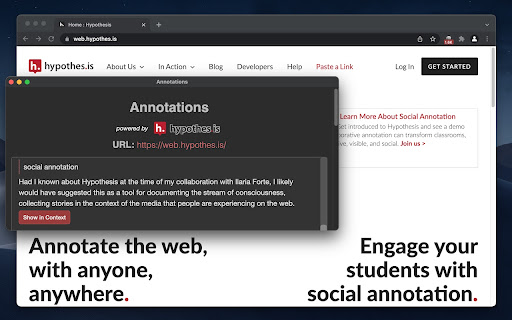
The Official Wayback Machine Extension - by the Internet Archive. Welcome to the Official Internet Archive Wayback Machine Browser Extension! Go back in time to see how a website has changed through the history of the Web. Save websites, view missing 404 Not Found pages, or read archived books & papers. Most features will work without requiring an account including Save Page Now. Some features must be enabled from Settings. Turn on Private Mode to prevent automatic sending of data and to protect your privacy while browsing. • Save Page Now - Instantly save the page you are currently viewing in the Wayback Machine. Turn on Auto Save Page in settings to save pages that have not previously been saved, or Auto Save Bookmarks to save when bookmarking a page. Works while logged out, or log in for additional options. • Oldest, Newest & Overview - View the first version of a page or the most recently saved in the Wayback Machine. Or view a calendar overview of all archived pages. Can also use by right-clicking over a page or link. • Wayback Machine Count - Display a count of snapshots of the current page stored in the Wayback Machine over the toolbar icon, and the date of last save in the popup. • Contextual Notices - Check for contextual information from fact checking organizations and origin websites. • Relevant Resources - View research papers and books while visiting Wikipedia, archived digitized books while visiting Amazon Books, and recommended TV News Clips while visiting news websites. • URLs & Collections - Show a list of URLs captured under the current website, and what collections they are saved under. • Site Map & Word Cloud - Present a sunburst diagram for the domain you are currently viewing, or create a Word Cloud from the link's anchor text of the page you are on. • Annotations - Provide a list of annotations for the current web page and domain, provided by Hypothes.is. • My Web Archive - Save URLs to your public archive page on the Internet Archive. • Tweets & Share Links - Search Twitter for information regarding your current page, or share archived links on social media. For support, please email info@archive.org

Fake news debunker InVID WeVerify VeraAI
InVID WeVerify VeraAI extension This plugin has been designed as a verification “Swiss army knife” helping journalists, fact-checkers, and human rights defenders to save time and be more efficient in their fact-checking and debunking tasks on social networks especially when verifying videos and images. This browser extension was enriched with new tools, developed within the Horizon EU research and innovation action vera.ai (2022-2025; https://veraai.eu/). In 2021, the plugin won a US Paris Tech challenge first prize award granted by the US Department Global Engagement Center (GEC). For the Poynter Institute, home of the International Fact-Checking Network (IFCN), it is "one of the most powerful tools for spotting misinformation online". This toolbox allows you to quickly get contextual information on Facebook and Twitter images and videos, as well as on Youtube videos, to perform reverse image search on several engines, to query the new Database of Known Fakes (DBKF), to fragment videos from various platforms (Facebook, Instagram, Youtube, Twitter, Daily Motion) into keyframes, to enhance and explore keyframes and images through a magnifying lens, to query Twitter more efficiently through time intervals and through a new Social Network Analysis module, to read video and image metadata, to check the video copyrights, to quickly search for fact checks or cross-network queries, and to apply a new enhanced forensic toolbox on images suspected of being manipulated. Another new forensic module, CheckGIF made in the EnVisu4 IFCN project, allows you to create a GIF between a manipulated image and an original one to better reveal the manipulation. New beta tools, for registered users, include a synthetic image detector from vera.ai project and an audio voice cloning detector provided by the US company Hiya.com after acquisition of the Spanish startup Loccus. An assistant feature will help you to find which tool can be used to support your verification work. The plugin is currently provided in English, French, Spanish, Greek, Arabic, Italian, German, Japanese, Portuguese (Brazil) and Hungarian language. A demo and a classroom section provide examples of manipulated images or videos together with explanations and media literacy tools and tips about the information verification process, for teachers and scholars. New tools developed in the IFCN DisinfoArchiving project (2024-2025) allow you (upon registration) to better archive traces of disinformation using the WACZ format (Web Archive Collection Zipped). A feedback button is available directly in the interface. Thanks to use it to report any bug, any issue (providing the link of the media to be checked), or any improvement suggestion, in this way. We welcome and need your feedback. Thank you. The plugin respects your privacy and no personal data is recorded. Caching of content is used by various partner tools for about one day to significantly improve UX. We use Matomo to better understand usage but you can opt out if you wish so (from the checkbox at the bottom of the About page). Some features (Twitter SNA, CheckGIF, GIF export on forensic toolkit) are reserved to fact-checkers, journalists and researchers due to the high demanding computer power needed and to avoid misuse. All versions of the plugin has been developed so far by AFP Medialab R&D through three EU-funded research projects and underlying web services provided by scientific partners. It was initially launched in July 2017 during the InVID European project, a EU Horizon 2020 innovation action (grant agreement 687786; https://www.invid-project.eu ; @InVID_EU). Then, it was enhanced with more tools during the EU Horizon 2020 WeVerify project (grant agreement 825297; https://weverify.eu/ @WeVerify). Currently, the plugin is part of the Horizon vera.ai project (Grant Agreement 101070093; https://twitter.com/veraai_eu) aiming to use artificial intelligence versus disinformation. Existing tools using AI will be enhanced and new tools will be co-created with end-users. Disclaimer: this software is provided "as is", without warranty of any kind, express or implied, including but not limited to the warranties of merchantability, fitness for a particular purpose and non infringement. In no event shall the authors or copyright holders be liable for any claim, damages or other liability, whether in an action of contract, tort or otherwise, arising from, out of or in connection with the software or the use or other dealings in the software.

RevEye Reverse Image Search
Perform a search by image. Choose between the image search engines Google, Bing, Yandex, TinEye, or user-defined engines. This extension allows to perform an inverse image search by right-clicking onto any image in a web site. You can configure the context menu to contain either a single button with your default search engine, or a cascaded menu with all included search engines. You can also add custom search engines through the options menu. RevEye is free and open source software. To minimize its memory footprint in your browser, it is written in pure vanilla JavaScript and it does not use any of the fancy JavaScript frameworks. RevEye does not track any of your data, and it does not include ads. Source code and more info: https://github.com/steven2358/reveye Changelog: - v2.0.0 (2024-08-30): Updated to manifest v3. Added option to add custom search engines. Refactored code. - v1.5.2 (2022-11-13): Replaced Google Image Search by Google Lens. - v1.5.1 (2021-01-19): Fixed a bug in upgrade/initialization script. - v1.5.0 (2021-01-18): Add checkboxes to enable/disable individual search engines. Removed Baidu (for now). - v1.4.8 (2020-11-24): Fixed Yandex search. - v1.4.7 (2019-06-14): Removed unnecessary permissions. - v1.4.6 (2019-06-14): Fixed Yandex search. - v1.4.5 (2017-07-23): Fixed Baidu search. - v1.4.4 (2015-05-20): Re-included Yandex and Baidu search. - v1.4.3 (2015-05-19): Included Bing image match. - v1.4 (2013-06-28): Performed security changes and updated manifest to v2. Removed Yandex, Baidu, Cydral. - v1.3 (2011-06-17): Included Google (brand new and kicking), Yandex and Baidu image search engines. Removed GazoPa as they discontinued their B2C service. - v1.2 (2011-05-30): Name change to comply with Google's branding policies. Added Cydral search engine. Added option to choose between default engine or cascaded submenu. - v1.1 (2011-03-01): Added option to select between TinEye and GazoPa search engines. - v1.0 (2010-03-02): Added context menu. - v0.2 (2009-12-14): Included new logo. - v0.1 (2009-12-13): Initial version. Performs reverse image search of all images on a page using TinEye.

Hunchly 2.0
Hunchly is a tool to capture and organize online data for your investigations. Requires the Hunchly app (https://www.hunch.ly) - Never take a screenshot again! Hunchly captures the web content you visit automatically, and makes it much easier to stay organized. - Stay focused on what matters - the investigation! Hunchly works quietly in the background, and with the blacklist and capture toggle, you can make sure you're only capturing what you need. - Page you saw got taken down? No probblem! Hunchly makes highly accurate offline copies in case the page you visited gets taken down or changed. - Protect against tampering! Every page, image, and attachment in Hunchly is given a unique fingerprint ("hash") at capture.

Webrecorder ArchiveWeb.page
Create high-fidelity web archives directly in your browser When enabled, ArchiveWeb.page will record the network traffic on a given tab and stores the data in the browser for later viewing. Archives created with ArchiveWeb.page can be viewed from right within the app, or using Webrecorder's free ReplayWeb.page viewer. Files can be exported in standard WARC and WACZ formats.