ajhcbjjgonogiifldoofdeonjclcehkh
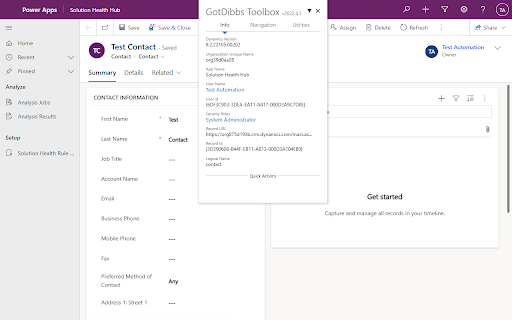
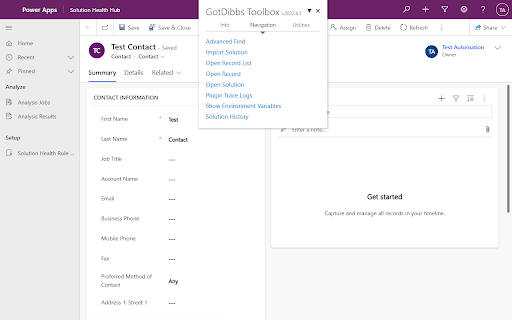

Admin tools for Dynamics 365/Power Apps Quick tools and shortcuts to assist with development in a Dynamics 365 environment. Includes: - Display of Organization Unique Name, Dynamics Version, User Id, Security Roles (and links to edit them), Record Id, Record Url, etc. All of these points can be double clicked to copy them to the clipboard. - Navigation helpers to get you quickly to: Advanced Find, Solution Import, etc. You can even open a solution if you know it's unique name. - Dev/Admin Utilities like: enable all fields on a form, list dirty fields, show record properties window, enable ribbon debugger. - Keyboard shortcut to open the toolbox: Alt + Shift + G, otherwise click on the box icon that's added to your browser actions next to your address bar. Come visit us on GitHub to make suggestions for what comes next: https://github.com/gotdibbs/Dynamics-365-Toolkit

xRM MDA
Productivity tools for Power Apps Makers xRM MDA is an extension for Power Apps model-driven apps and maker pages. It combines naming rules, record helpers, metadata navigation, JSON payload tooling, and generated documentation in one extension. Some utilities are familiar to teams that already use Level Up style tooling. The difference here is the shortcut-first workflow, the reusable template flow, and the additional maker-focused documentation and naming features. (Special thanks to Natraj Yegnaraman and Level Up for Dynamics 365 for their contribution to the Dynamics 365 maker community.) - Keyboard shortcuts for high-frequency record and metadata actions. - Metadata launch from both record context and list context. - Reusable template workflow for saving and reapplying form values. - JSON object manipulator for record payload inspection, editing, create, update, and template work. - Context-aware naming rules across maker surfaces. - Built-in documentation views for forms, workflows, diagrams, and security. - Navigation explorer for moving between table metadata surfaces from inside the app. xRM MDA is designed for users who want frequent actions on the keyboard instead of repeated popup interaction. - Alt+F to set a fake value on the current record or fill the full form. - Alt+F+N to set fake values in a new record. - Alt+G to toggle Godmode. - Alt+N to show or hide logical names. - Alt+C to clone the current record. - Alt+I to copy the current record ID. - Alt+M to open metadata tools for the current entity. Record and testing utilities - Clone the current record. - Copy the current record ID. - Show or hide logical names. - Toggle Godmode while customizing or testing. - Keep Godmode and logical name visibility available across navigation. - Fill the current form with fake data. - Fill a new record with fake data. - Reuse saved values through templates. The extension includes a persistent template workflow for repeated test and setup scenarios. - Save current form values for reuse. - Store templates from the popup and JSON tooling surface. - Reapply templates on later records. - Use templates together with fake-fill and payload editing flows. The JSON object manipulator is one of the main advanced features in xRM MDA. - Inspect record payloads directly. - Edit values in a JSON-oriented view. - Open existing records or create new ones. - Run update and create style operations. - Work with relationships. - Add empty properties. - Randomize values. - Save payloads as templates. - Open metadata tools from the current record. - Open metadata tools from the current list view. - Use the navigation explorer to search tables and jump between metadata surfaces. Naming and maker automation The naming engine applies rule-driven naming behavior across maker experiences. - Global publisher prefix configuration. - Table naming rules. - Column naming rules. - Column data-type overrides such as lookup, yes/no, choice, and text. - Form naming rules for tabs and sections. - Template token support in form naming rules. - Web resource path and extension rules. - Process naming support. - Warning when the detected publisher prefix does not match the configured global prefix. Documentation and analysis features - Form documentation with field metadata. - Filters for fields, tabs, and sections. - Visual state indicators such as required, read-only, and audit state. - Workflow cross-reference with triggering attributes. - Visibility into workflows, business rules, BPFs, plugins, and Power Automate. - Relationship diagrams with SVG and Draw.io export. - Security role matrix by privilege depth. - Word export of collected documentation. - Power Platform makers. - Dynamics 365 consultants. - Admins. - Solution engineers. - Teams that repeat the same record setup and testing flows. - Teams that want more keyboard-driven execution. - Teams that want naming automation and documentation in the same extension. If your team already uses Level Up style utilities, xRM MDA is strongest where you need: - More direct shortcut-driven execution. - A stronger template and fake-fill workflow. - JSON payload editing from inside the extension. - Naming automation for maker surfaces. - Built-in documentation, relationship, and security views. xRM MDA is focused on faster maker workflows inside Dynamics 365 and Power Apps through shortcuts, templates, fake-fill tools, naming rules, metadata entry points, JSON payload tooling, and technical documentation views.

Power Console - Dynamics 365 Developer Toolkit
Dynamics 365 & Power Platform DevTools. Inspect entities, metadata, forms, processes & records with structured output. The essential browser extension for Dynamics 365 and Power Platform developers. Power Console gives you instant, structured access to metadata, records, forms, processes, users, and environment details — all from a beautiful in-page overlay, with zero setup required. Stop switching between browser tabs, digging through DevTools, or writing one-off scripts. Open Power Console's popup, click a feature, and get results displayed in a modern, searchable, filterable modal — right on top of your Model-Driven App. • Copy Record ID — Instantly grab the current record's GUID with one click. Copies to clipboard automatically. • Primary Field — Retrieve the primary field's logical name, display name, and current value for the open record. • Fields Metadata — View every field on the current record with its logical name, display name, data type, requirement level, current value, and whether it's custom. Presented in a searchable, sortable table with column filters. • Option Set Values — Inspect all option set (choice) and boolean fields on the record. See every option with its label, numeric value, and which option is currently selected — displayed as interactive pills you can click to copy. • Record Owner — See who owns the record (user or team), with owner name, type, and ID. • Entity Metadata — Full metadata for the current entity: logical name, display name, plural name, primary key, primary field, schema name, entity type code, ownership type, and more. • Set & Collection Name — Quickly retrieve the entity set name and collection name for Web API calls. No more guessing plural names. • Entity Relationships — Browse all 1:N and N:1 relationships in a dedicated sidebar + detail panel. Filter by relationship type, search by schema name, related entity, or lookup attribute. Each relationship shows schema name, related entity, lookup attribute, referenced attribute, navigation property, custom/managed/customizable flags, and the full Web API path — with copy buttons on every value. • Field Dependencies — Select any field on the current entity and instantly discover every dependency: calculated fields, business rules, workflows, plugins, charts, views, forms, and more that reference that field. Results are grouped by dependency type in an accordion layout with counts, search, and category filters. • Form Info — Get the current form's ID, label, and entity name in one click. • All Registered Events — A dedicated, modern renderer for form events. See a hero stats banner with color-coded cards for OnLoad, OnSave, OnChange, and Overall handler counts — each with active/total numbers and segmented progress bars. Below that, handler cards show: Color-coded event type pill (OnLoad blue, OnSave green, OnChange purple) Function name in monospace with a copy button Library name badge Trigger field (for OnChange events) Enabled/Disabled status with icon Pass Execution Context indicator Parameters in a monospace chip Filter by event type with chip buttons (counts update dynamically), toggle "Enabled Only" to hide disabled handlers, or switch to "Group by Library" mode to see handlers organized under accordion sections per web resource. Full search across function names, libraries, fields, and parameters. • Structured JS Object — Generates a complete JavaScript object representation of the current form's structure: all tabs with their sections, all fields mapped by display name to logical name, and all option sets with their label-to-value mappings. Output as raw JSON — ready to paste into code. • All Forms — List every main form available for the current entity, with form ID, name, and which one is currently active. • Processes — List all workflows (Classic Workflows, Power Automate flows, Actions, Dialogs) registered for the current entity. See name, category, type, mode (real-time vs background), scope, status, triggers, and whether they run on-demand. Filterable by type, execution mode, trigger conditions, and on-demand availability. Navigate directly to the process record or Power Automate designer with click or Shift+click. • Plugins — View all custom plugin step registrations for the current entity. Inspect stage (Pre/Post), execution mode (sync/async), message (Create/Update/Delete), filtering attributes, rank, and whether the step is enabled. Searchable and filterable. • BPF Details — Inspect every Business Process Flow associated with the current entity. Accordion view shows each BPF with active/inactive badge and full stage list (stage name, stage ID with copy button, stage category). The active BPF is auto-expanded. • Active Stage — Instantly retrieve the currently active BPF stage name and ID. • User Info — Current user's full name, email, domain name, user ID, and business unit — all in one view. • Security Roles — Complete list of the current user's security roles, including roles inherited through team membership. Each role shows its name, source (direct or team), and role ID. • Teams — All teams the current user belongs to, with team name, business unit, and the security roles assigned to each team. • Organization Info — Organization name, unique name, organization ID, version, and base URL. • Environment Info — Environment URL, unique name, version, base currency, and base language. • Environment Variables — Browse all environment variables in your environment with their definition display name, schema name, type, default value, and current value. Edit default values and current values inline — changes are saved directly to Dataverse with visual confirmation. Searchable and filterable. Install Power Console and supercharge your Dynamics 365 development workflow. Every piece of metadata you need — one click away.

c! Dynamics 365 Helper
Small and usefull js-functions to manipulate Dynamics 365 [Dyn365] (online). Small and usefull js-functions to manipulate Dynamics 365. You can get information about your user, the environment, the activity-storage-capacity and more. Even the oldschool advanced find is there ;). Also you will get the possibility to manipulate some data, but be aware: Use at your own risk. We do not collect any of your data. Contents of the extension: Area: 'CRM: View': Enabled in Views in Dynamics 365 - '->REST': Open the view-results in REST-Endpoint. Area: 'CRM: Record': Enabled for Records in Dynamics 365 - 'Godmode': Show all fields | No field is required | No field is disabled. - 'SchemaNames': Show all Schemanames of the visible fields on the form. - '->REST': Open in the record REST-Endpoint. - 'Properties': Show the basic properties of a record: CreatedBy and CreatedOn. - 'DirtyFields': Highlight changed fields on the form. - 'Reopen': Reopen a closed activity. - 'All Fields': Show all fields of this record and some metadata of them. - 'Test-Data': Populate all required fields with random data - Good for testing and debugging scenarios. Area: 'Info': Open some usefull links or data. Always enabled. - 'Send Link': Open an email with 2 links directing to the current opened record: One for this app and one teammember-friendly link without an appid. - 'Show my User': Open my User-record in Dynamics 365. - 'adv.Find': Open oldschool Advanced Find. - 'User-Data': Show security-relevant information for your systemuser. - 'open JsAPI': Open external link: Official JS API-Documentation - 'EntityTypeCodes': Show a table of all EntityTypeCodes and -Names (etc, etn) of this organisation - 'Component-Types': Show a table of all Componenttypes. Useful for getting rid of Dependency-errors. Area: 'Admin': Tools to Administrate Dynamics 365. Always enabled. - 'Edit': Pretty oldschool. Open the formeditor of this record in Make.Powerapps. Default Solution. - 'Table' - 'Open': Open the table in Make.Powerapps.com - 'Edit': Edit the table data in Make.Powerapps.com - 'EntityTypeCodes': Show all tables and their ETC. - '#Activities': Count all activities and show them as a table, grouped by year and activitytype. - 'RecordCount': Counts all records from one table. - 'RolesByTable': Get SecurityRoles by table. Filter by user/team. - 'ID': Opens a record with the id only. - 'Copy Roles': Copy BU, Teams, SecurityRoles of one user to another.

D365 Plugin Code Generator
Generate plugin code based on entity name and action The "Plugin Code Generator for MS CRM" Chrome extension likely provides a streamlined and automated way to generate code snippets or templates for plugins in Microsoft Dynamics CRM.